Fail-Closed AI Governance in Microsoft’s Agent Governance Toolkit
Two independent open-source contributions merged into Microsoft’s Agent Governance Toolkit: fail-closed handling for zero-required-stage approval chains and policy-fixture validation that prevents empty or invalid test suites from reporting false success.
Role
- Policy evaluation
- Security invariants
- Policy-test validation
- Regression engineering
- Cross-implementation parity
- Open-source engineering
Category
AI Governance & Policy Validation
Engineering discipline
MERGED UPSTREAM
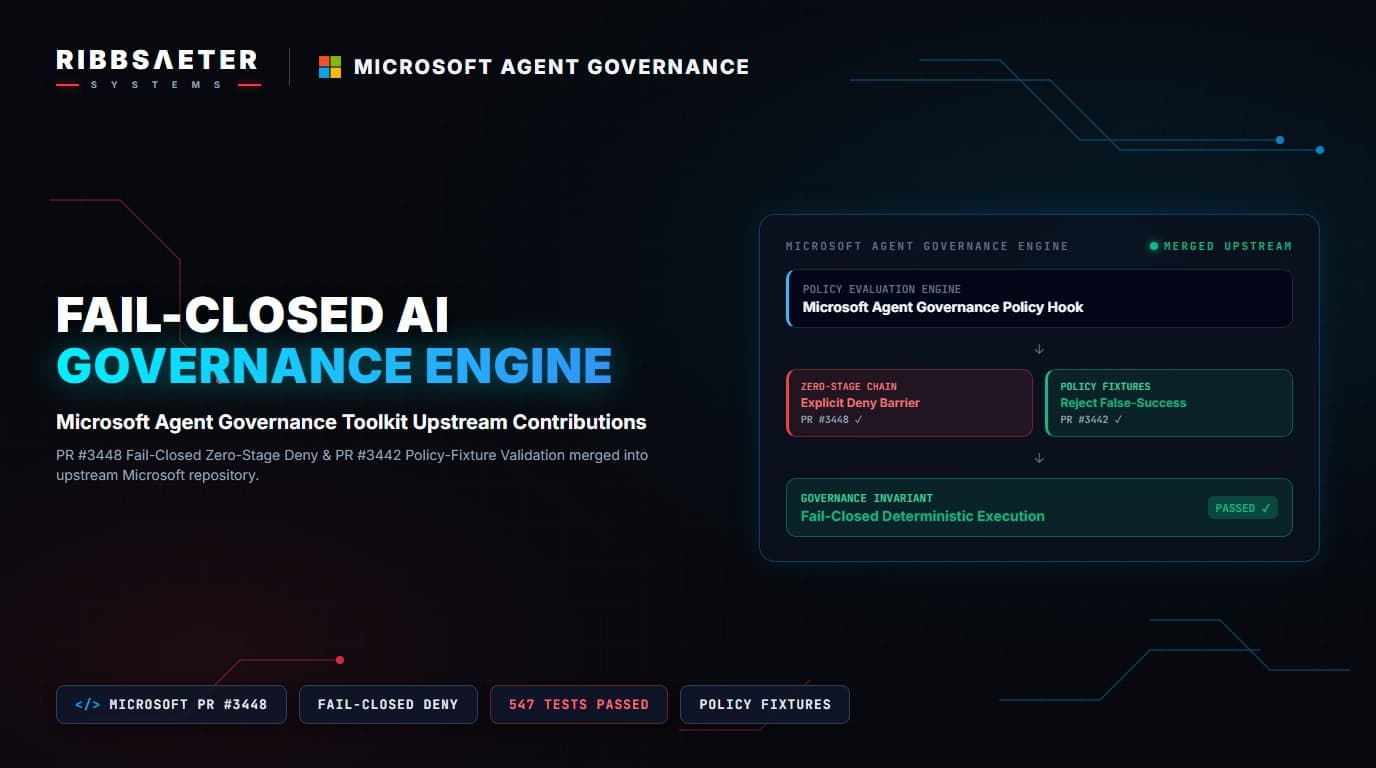
Patrick Ribbsaeter · Independent open-source contribution
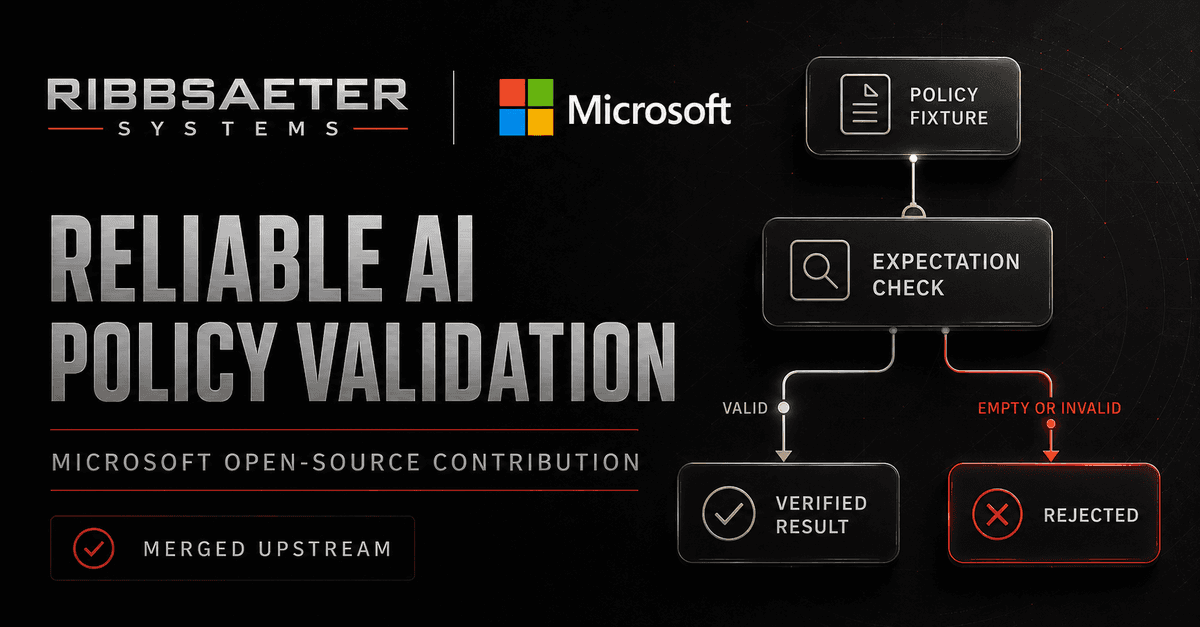
Policy-test reliability · Microsoft PR #3442 · Merged upstream
Engineering objective
System challenge
Two governance failure modes could create misleading authorization or test confidence. A zero-required-stage approval chain could satisfy empty-set containment and resolve toward ALLOW, while policy fixtures without meaningful expectations could complete without proving any outcome. Both conditions required explicit validation so incomplete governance state could never authorize execution or report false success.
Constraints
Working within real limits
- ✕Preserve valid approval behavior for correctly configured chains
- ✕Treat incomplete or ambiguous policy configuration as denied
- ✕Require at least one meaningful, non-null policy-test expectation
- ✕Prevent empty replay reports from being classified as successful
- ✕Verify persisted resolution, request state, execution authorization, and report semantics
- ✕Keep both upstream patches focused and reviewable
Architecture
System design
Approach
How it was built
- 01
Reproduced the zero-required-stage boundary with an optional non-advisory ALLOW decision.
- 02
Traced the approval failure to vacuous empty-set containment and introduced an explicit deny guard.
- 03
Verified that stored resolution, request status, and execution authorization remain denied.
- 04
Validated policy fixtures before execution and required at least one non-null expectation.
- 05
Changed empty replay-report behavior so a suite cannot report success without a meaningful assertion.
- 06
Added focused regression coverage and validated both patches through their relevant test suites.
Workflow
Implementation flow
Technical validation
Implementation evidence
Observable engineering evidence. Discipline: MERGED UPSTREAM
Upstream status
2 Microsoft PRs merged
Human review
Both approved
Approval security
PR #3448 · 26 tests
Policy validation
PR #3442 · 521 passed
Invalid fixtures
Rejected before execution
Security posture
Fail closed · no false pass
Public evidence
Review the upstream contribution
Outcome
What was delivered
Two independent contributions received human maintainer approval and merged into Microsoft’s upstream repository
PR #3448 resolved the zero-required-stage empty set edge case and passed 26 focused tests
PR #3442 rejected empty or null-only policy fixtures and passed 521 tests with 2 skipped
Python approval behavior aligned with the Go and TypeScript implementations
Governance tests now require meaningful assertions before reporting success
Technologies
Stack and tools
Next engineering system
CLIENT PRODUCTION · AI MEDIA INFRASTRUCTURE
Ethereal Casting: Global Synthetic Casting Platform
Have an ambitious AI system to build?
Let’s build something serious.
I work across AI architecture, product engineering, private inference, automation, SaaS infrastructure, and production hardening.